

Showing posts with label geology. Show all posts

Canadian Rockies: A Geologist's Paradise, National Geographic, June 1911

Charles D. Wolcott, secretary of the Smithsonian visits the Canadian Rockies. A look back to 1911, when science was first discovering the vast age of the earth, rich fossil record, and paleontology was still in its infancy.
National Geographic, June 1911

NATURE has a habit of placing some of her most attractive treasures in places where the average man hesitates to look for them. Twenty-five years ago rumors came of a wonderful find of glaciers, forests, mountain peaks, and lakes along the line of the rugged pass through which the Canadian Pacific Railway was building.

A geological reconnaissance by Sir George M. Dawson, of the Canadian Geological Survey,outlined some of the broader geological features, and a somewhat closer study by Mr. R.G. McConnell in 1886 resulted in a more accurate description of the thousands of feet in thickness of sandstone, shale, and limestone that had been arched and broken before being dissected and laid to view by the agents of erosion which formed the canyons, cliffs, and mountains by removing grain by gain or by chemical solution the material that formerly occupied or surrounded them.

A young American, Walter Wilcox, taking his surveying instruments and camera, spent summer after summer sketching maps and photographing the scenery, and in 1869 he published the first of several beautiful volumes on "Camping in the Canadian Rockies." Later, with the development of the Kodak, thousands of pictures were taken by tourists who had little thought of the geological treasures lying all about.

The study of the glaciers was begun early by an American, George Vaux, of Philadelphia, assisted by his sister Mary, and later an expedition sent out by the Smithsonian Institution under the leadership of William H. Sherzer, of the University of Michigan, resulted in the publication in 1907 of a memoir describing and illustrating many of the glaciers.

During the past three years an expedition from the Smithsonian has been making an examination of the four miles or more in thickness of bedded rocks forming the main range of the Rocky Mountains that has been pushed eastward by the great mass of the Selkirk ranges to the west. It is a curious and instructive feature of the geology that the strata of the Rockies, although crowded eastward and thrust out over the later rocks of the plains of Alberta, have not suffered nearly as much dislocation, injury, and alteration as the apparently more massive bedded rocks of the Selkirks. The latter are crumpled, broken, and altered in about the same manner as large blocks of brittle paper would be if subjected to side pressure in a hydraulic press.
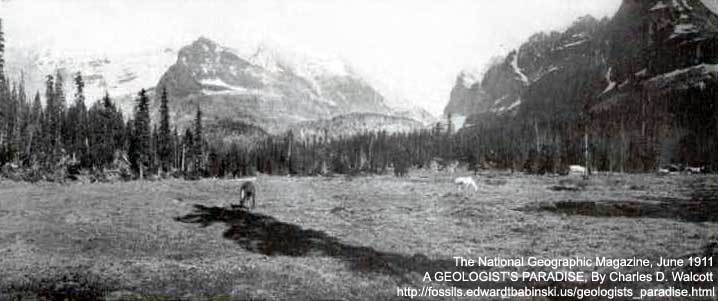
Camp Contentment
Camp Contentment Meadow, Above Lake O' Hara, At Foot of Mount Schaeffer
Photo by Charles D. Walcott

MOUNTAIN-BUILDING ON A GRAND SCALE
The study of the arched block of strata 16,000 feet or more in thickness from which the picturesque and impressive mountains and canyons have been carved has resulted in the discovery that the rocks in which the great Bow Valley is excavated form a part of the North American continental beds that were deposited in great fresh-water lakes before the waters of the ocean swept over the continent and began their task of depositing the 12,000 feet or more in thickness of rocks of Cambrian age that now contain the remains of the marine life of that period.

As the study of the formations developed it was found that in the eastward thrusting of the rocks massive limestones were often crushed and ground into fragments; in other places the thinner beds for 100 feet or more would be folded and crumbled between huge masses of even-bedded limestones that showed no traces of disturbance. In other places a series of beds, 1000 feet or more in thickness, met some obstacle which they could not crush or surmount, and were driven upward at almost right angles, forming series of sharp, ragged ridges. On the east side of the Lower Yoho Valley the limestones of Mount Ogden are lying nearly level, but on the eastern slope above Sherbrooke Lake Canyon the same beds are turned down at right angels and disappear beneath the canyon bottom. Everywhere the keen eye of the geologist will find evidence of mountain-building on a grand scale.

The panoramic photograph, taken by the author from Burgess Pass, 3,000 feet above Field, and published as a Supplement to this number of the NATIONAL GEOGRAPHIC MAGAZINE, shows at a glance over 9,000 feet in thickness of bedded rocks, 6,000 feet of it in an almost sheer cliff in the mass of Mount Stephen. Many thousand feet more may be seen to the westward in Mount Denis and in Mount Vaux. From Mount Stephen the eye follows to the left across the great canyon of the Kicking Horse River to the summit of Mount Field, two miles away, where the same limestone and shale beds carrying the same fossils indicate that thousands of feet in thickness and many millions cubic yards of hard rock have been removed by erosion from between the two mountains, Stephen and Field. From Mount Field a gentle slope carries the same beds northward through Mount Wapta, where they undulate across the President Range and plunge to the westward beneath the corrugated and more readily broken Ordovician rocks of the Van Horne Range.

EARLY MARINE LIFE
All of the Cambrian rocks were deposited in waters teeming with marine invertebrate life. As far as now known, this was before the day of fish or of any other vertebrate animal; land plants and even marine vegetable life were almost unrepresented. Other animals of the sea, however, existed in great profusion, and here and there conditions were so favorable for their burial in the mud and sand of the Cambrian sea that they were preserved unbroken, and throughout all the processes of rock-making and mountain building they have escaped destruction.

In one of these favorable places the most delicate of organisms, like the jellyfish, have been exquisitely preserved and we have crustaceans of many varieties. Among these many preserve the most delicate branchiæ and appendages, and one can hardly realize that they were buried in the mud 15 to 20 million years ago and have remained undisturbed while several miles of thickness of sediment were deposited over them, changed into rock, elevated into mountain masses, and later eroded into the present mountains and canyons.

We have long considered that the trilobite (page 516) was the most highly developed animal in the Cambrian time, but last summer a crustacean was found by the author in the fossil bed near Mount Wapta that was the king of the animal world in its day (page 517). That it was prepared to asset its right to the control of the Cambrian sea is shown by the claws with which it was armed.

To the geologist interested in the volcanic rocks a great field is waiting in the Selkirks to the west, and for generations to come there will be unsolved problems for the special student in this great region of mountains, glaciers, and rivers.

SUMMARY OF GEOLOGIC FORMATIONS
In the long panoramic view the rocks seen in the distance, forming Mount Balfour, belong to the Sherbrooke formation of the Upper Cambrian, or the most recent rocks of the Cambrian section. Beginning with these and going downward, the following formations are passed through:
UPPER CAMBRIAN

  • Sherbrooke formation (mainly limestones) 1,375 feet
  • Paget formation (limestones and shales) 360 feet
  • Bosworth formation (limestone and shale) 1,855+
    Total Upper Cambrian 3,590+
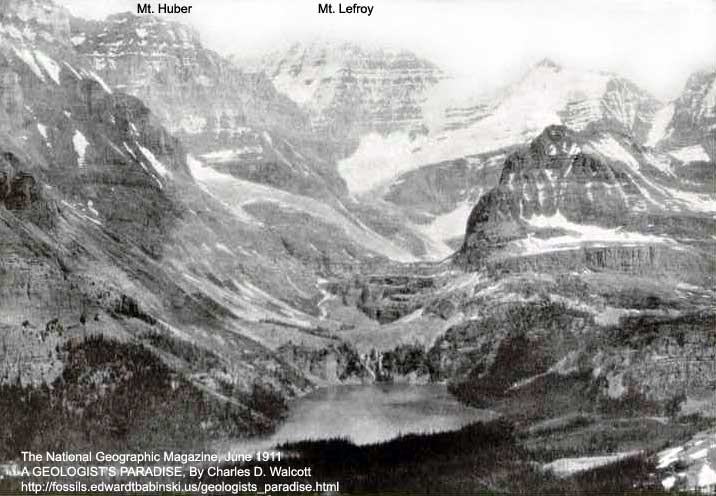
Lake O'Hara
Lake O'Hara (6,664 Feet) Rests In A Bowl In The Mountains
From the lake to the top of Mount Lefroy 4,000 feet of Cambrian strata are seen in one unbroken section.
Photo by Charles D. Walcott
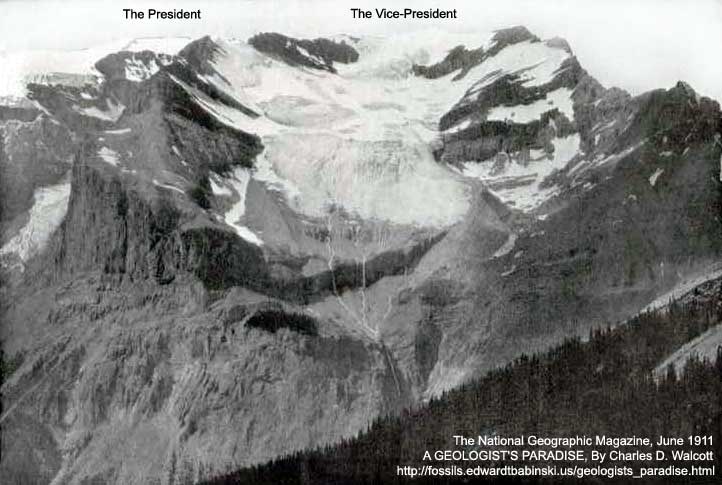
President Range
View Of The President Range From A Point On The Trail On The West Slope Of Mount Wapta, 3½ Miles In An Air Line North Of Field, On The Canadian Pacific Railway, British Columbia, Canada
This view shows Emerald Glacier after a light snow-storm has whitened the ice. Note particularly the two lateral moraines formed of broken-up light gray limestone (see page 520).
Photo by Charles D. Walcott
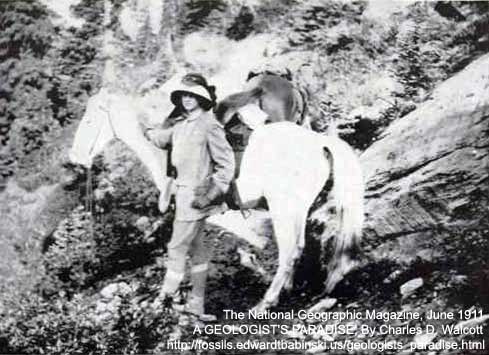
Burgess Trail
Waiting On The Burgess Trail Under Mount Wapta
Photo by Charles D. Walcott

MIDDLE CAMBRIAN

  • Eldon formation (siliceous and arenaceceus limestones) 2,700 to 2,800
    This is the formation that caps Mount Stephen and may of the higher mountains.
  • Stephen formation (limestones and shale) 620
  • Cathedral formation (arenaceous limestones) 1,543
    Total Middle Cambrian 4,963

LOWER CAMBRIAN

  • Mount Whyte formation (limestones and sandstones) 390
  • Saint Piratt formation (sandy shales and sandstones) 2,705
  • Lake Louise formation (siliceous shale) 105
  • Fairview formation (sandstones) 1,324
    Total Lower Cambrian 4,524

SUMMARY
Upper Cambrian 3,590+
Middle Cambrian 3,963
Lower Cambrian 4,524
Total thickness of Cambrian section 13,077+

Beneath the old Cambrian sea-beach now forming the base of the Fairview formation there is a great series of sandstones and sandy shales of quite a different character. These rocks formed the land area which was submerged by the Cambrian sea that wore them away more or less in its advance over the continent.

These older rocks are supposed, owing to their character and the absence of marine fossils, to have been deposited in fresh water. They are referred to a series called Algonkian, and are divided into two formations:

  • Hector formation (sandstones and shales-gray, black, greenish, purple in color)... total thickness.. 1,302
  • Corral Creek formation (sandstones)...1,320

THE WASTING AWAY OF THE MOUNTAINS
The breaking down of the mountain summits by the action of rain, frost, and ice, so as to form strong pyramids and ridges, is constantly going on. This is well shown by the photograph of Mount Huber, on page 518.
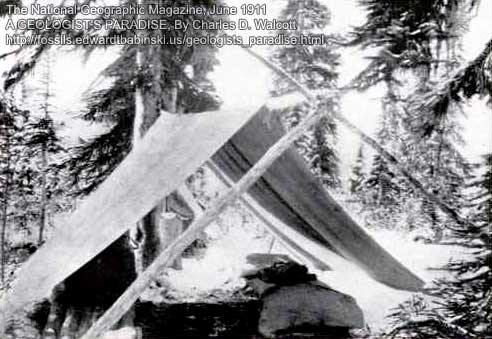
7000 Feet Above Sea Level
A Cool September Morning At 7,000 Feet Above Sea-Level
Photo by Charles D. Walcott

An illustration of a long summit ridge is given by Mount Daly, where every summr storm leaves a fresh coating of snow. I well recall stepping off that limestone onto the snow, thinking it hard and secure, and dropping in up to my armpits within a few feet of the rock. We were glad to paddle our way back and follow the rocky ridge for miles around to get back to camp.

Some of the deep canyons were filled up for 1,000 feet or more by dirt, gravel and boulders washed down from the sides of the mountains, probably during the great Glacial period. Upon the withdrawal of the ice this accumulated material was rapidly cut away, but occasionally masses of it are left high on the sides of a mountain, and often most fantastic forms result from its erosion where the finer beds of gravel and clay are hardened and protected above by blocks of sandstone and limestone. One of the most noteworthy examples is that of the so-called Hoodoos, on the slope of Mount Vaux, 18 miles west of Field.
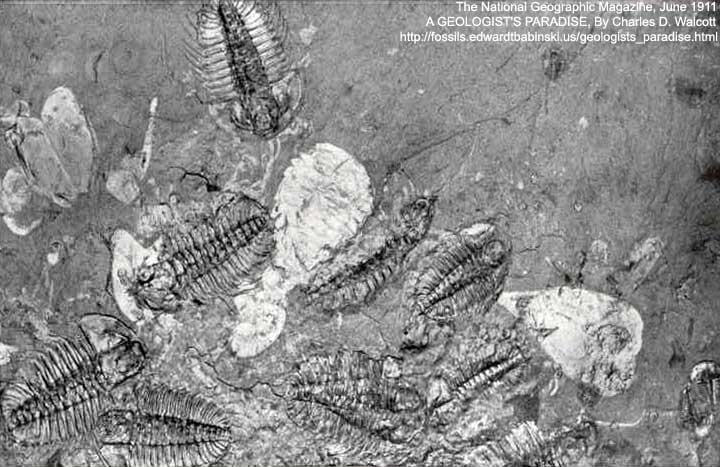
Trilobite Fossils
Fragments Of A Colony Of Marine Animals On A Slab Of Black Rock, With Many Trilobites (Dark) And Shells Of The Sidney Crab (Light), Whose Claws Are Shown On Page 517
These creatures and other animals, like the delicate jelly-fish, have been preserved many millions of years while sediment several miles deep was deposited over them (see page 511).
Photo by Thomas W. Smillie
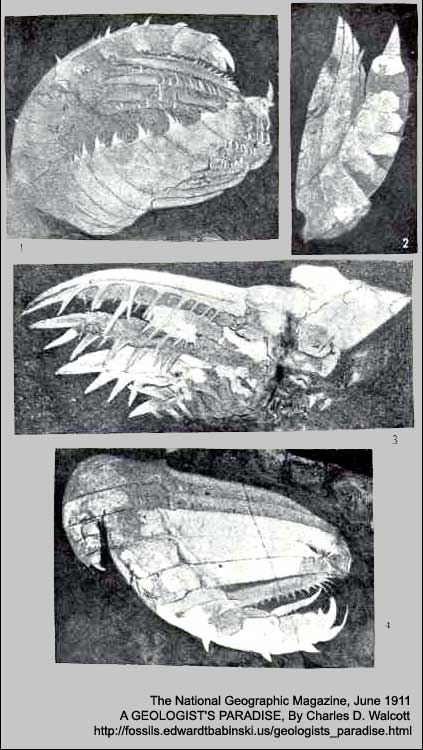
Middle Cambrian Crustacean
The King Of The Animal World 15 Million Years Ago; Discovered By Mr. W. Alcott
The Spiny claws of the Middle Cambrian crustacean (Sidneyia inexpectans), shown as a light patch in the center of the figure on page 516 (see page 511).
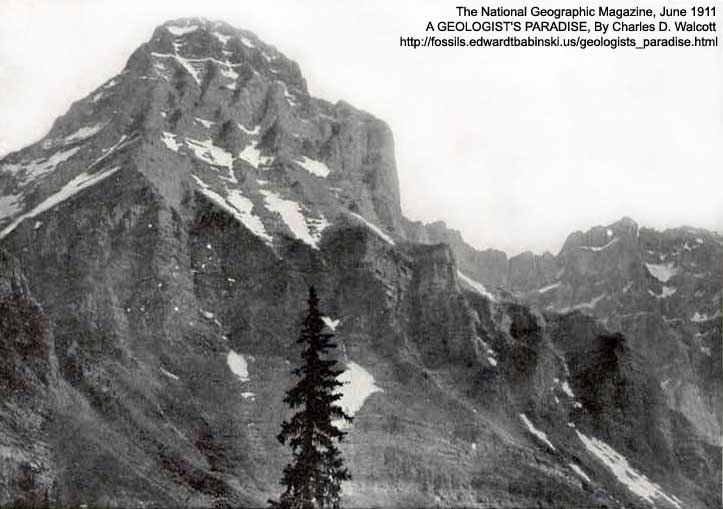
Mt. Huber Cambrian Erosion
View Of Mount Huber, Showing The Erosion Of The Massive Cambrian Limestones Above The Quartite Sandstones
View taken from a low ridge of Lake O'Hara, six miles south of Hector, on the Canadian Pacific Railway, British Columbia, Canada (see page 514).
Photo by Charles D. Walcott
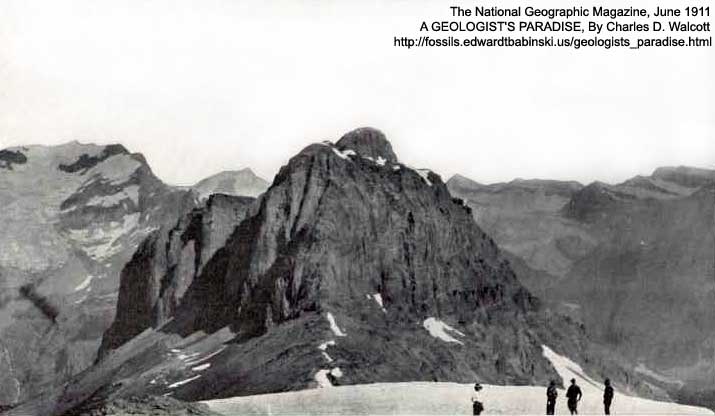
Mount Wapta
Cooling Off After A Hard Climb Up Through The Limestones
Panoramic view, at 9,000 feet, of the south face of Mount Wapta from the summit of Mount Field, 4,600 feet above Field, on the Canadian Pacific Railway, British Columbia, Canada.
Photo by Charles D. Walcott
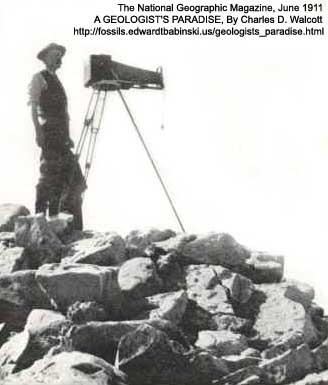
Summit of Mount Field
The Author Ready To Take A Panoramic View From Summit Of Mount Field
Photo by Sidney S. Walcott

TAKING THE PHOTOGRAPHS
The panoramic photographs were taken with the Cirkut camera that is used by newspaper men and others for photographing processions and obtaining panoramic views of buildings, railway lines, etc. For use in the mountains several minor changes were made, so that the instrument could be used successfully under such adverse conditions as strong winds, hands and fingers numbed from cold, and often very insecure foundation for the tripod. As it is necessary to have absolute stability and the camera-bed level, the securing of perfect negatives is difficult.

The camera consists of the ordinary 6½ by 8½ outfit, with a panoramic attachment which is 10½ inches square by4 inches in thickness. When the latter is used the tripod head is a 12-inch graduated circle with the revolving bed above A ratchet, driven by springs, moves the camera around the circle, the speed being governed by fans. Our lens is a Bausch and Lomb Zeiss Protar, Series VII.

The long panoramic view had an exposure of one-tenth of a second over each part of the film. The film moves past a vertical half-inch aperture from right to left as the camera is revolving from left to right. With this instrument a view can be taken 8½ inches in height and of any desired length up to 10 feet. Two persons can readily carry the outfit anywhere that one can ordinarily climb. Under unusually difficult conditions the camera can be drawn up by a rope.

Often in the Canadian Rockies days will pass in which the atmospheric conditions are unfavorable for an extended view--dust blown in the plains, smoke from forest fires, or the indefinate summer haze and cloudy weather interfering. The best conditions usually occur just after a heavy storm of either snow or rain has cleared the air.

One really great panoramic view and a half dozen fine smaller views is a successful season with the camera when it is used as an adjunct to hammer and compass in geologic work.

From the vicinity of the Burgess Pass camp the views were most beautiful and varied, and changed from hour to hour during the day and from day to day with the varying atmospheric conditions. Emerald Glacier, directly facing camp (page 513), was always attractive, whether in the bright sunlight, the gray light of early morning, the shadows of sunset, or when snow and fog were sweeping over the range, giving only now and then a glimpse of the ice and cliffs. The light-colored moraines on either side of its foot and the dark rocks afforded a beautiful setting for the glacier. Across the Yoho Pass the cliff of Mount Wapta stood in bold relief, with a steep slope of broken rock on the western side and a huge bank of snow on the eastern side of its south ridge.

Rising back of camp was the beautiful cliff of Mount Burgess, a favorite haunt of the mountain goat. At its eastern foot on the narrow ridge is the point where the great panoramic view was taken. Far below and almost at the foot of the great cliff is Emerald Lake, a spot famous for its scenic beauty. Our camp in the forest just below the ridge was visited quite frequently in September by heavy snow squalls that gave a welcome opportunity for a day's rest, reading, and cleaning up.

Our camp at Lake O'Hara was in a beautiful mountain meadow at the foot of Mount Shaffer. Morning and evening the views of the surrounding mountains were most inspiring. At this elevation (7,000 feet) snow squalls were not infrequent on the higher summits above, and on July 17 snow fell at the camp most of the day. From a slope of Mount Odaray, Lake O'Hara, resting like an emerald in a bowl of mountains (see page 512), reflected the glaciers of Mounts Lefroy and Hungabee.

Camping in the Canadian Rockies is a relatively simple affair if one is accustomed to going about with saddle and pack animals for conveyance. It is not difficult to obtain good camp outfits with horses and men, and much of the most beautiful scenery can be visited without riding on a trail or leaving wagon roads. Firewood and good water are well distributed and grass for the horses usually abundant.

OUR MOUNTAIN PANORAMA
NO ONE would be more surprised and delighted with Mr. Walcott's beautiful panoramic view, which is published as a Supplement to this number, than the American scientist whose discoveries gave a practical value to Daguerre's invention of photography, and the 100th anniversary of whose birth was celebrated last month. It s only 72 years since John William Draper in New York took the first photograph of a human face, but the progress in the photography art since then is amazing.

Mr. Walcott's panorama is the most marvelous mountain view that has ever been published, and is remarkable not only for its exceeding beauty, but also because of the many lessons in geography learned by studying it.

Readers of this Magazine who have attempted to take photographs in high altitudes can appreciate the combination of patience and skill required to secure a panorama like our Supplement. Weeks usually elapse before the weather is favorable, and then the slightest error of judgment may make the exposure a complete failure.

Perhaps equally difficult is the engraving, printing, and handling of 100,000 copies of 9-foot picture. For the success of this part of the publication the NATIONAL GEOGRAPHIC MAGAZINE takes pleasure in acknowledging its indebtedness to the Matthews-Northrup Works, of Buffalo.

A few copies of the panorama have been printed on heavy art mat paper suitable for framing, and may be obtained at the office of the National Geographic Society at 50 cents per copy.

SCENES IN THE CANADIAN ROCKIES
THE scenes in the Canadian Rockies, published on pages 522 to 530, are all from photographs by Rev. George Kinney, of Keremeos, B.C., Canada, who, with his companion, Duncan Phillips, has the distinction of being the first to ascend to the summit of Mount Robson, the highest mountain yet discovered in the Canadian Rockies.

Mount Robson is situated in the heart of the Rockies, some 50 or more miles north of Yellowhead Pass and hundreds of miles from civilization. The mountain can be reached ony by pack-train after long weeks of strenuous endeavor through trackless forests and muskeg.
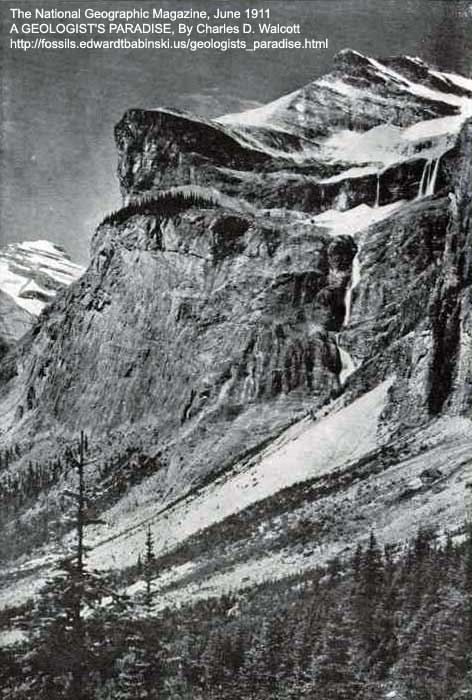
Mount Vice President
A Shoulder Of Mount Vice-President, Overlooking Emerald Lake, Near Field, British Columbia
The upper falls in the photograph are about 200 feet high.
Photo by Rev. George Kinney
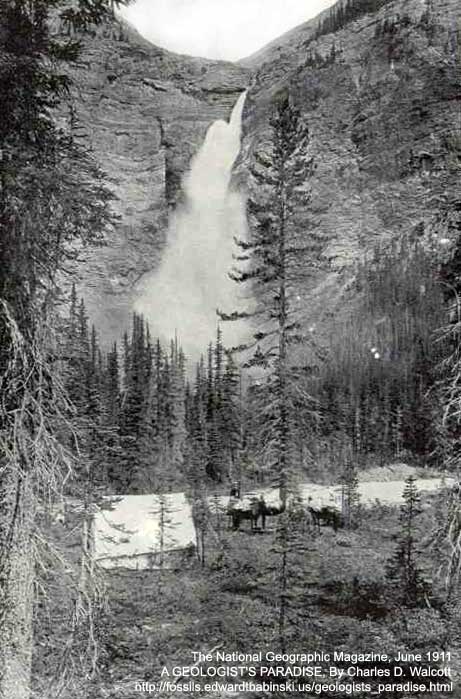
Takakkaw Falls
Takakkaw Falls (1,200 Feet), In The Valley Of The Yoho, British Columbia
Fed by the great Daly Glacier, which is backed by a snow-field of many square miles in extent, the Takakkaw Falls leaps full fledged over a cliff 1,200 feet high, thus forming the crowning wonder of the marvelous Valley of the Yoho, near Field, B.C., in the Canadian Rockies.
Photo by Rev. George Kinney
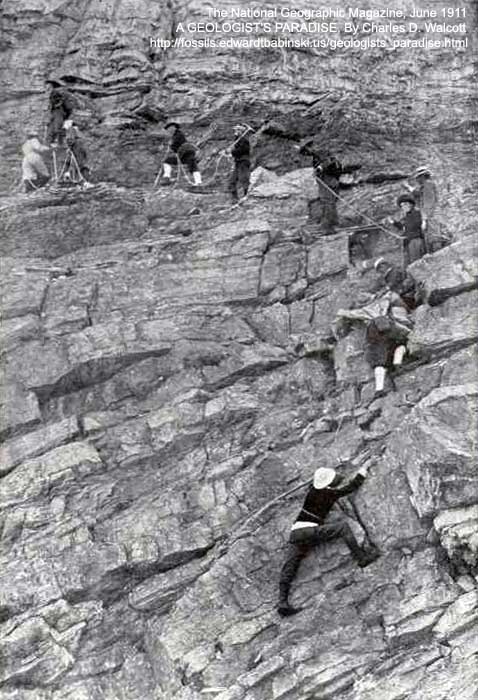
Ascending Mt Vice President
Members Of The Alpine Club Of Canada Ascending Mount Vice-President
A difficult piece of rock-work. Under the care of expert guides the members thus qualify for active membership.
Photo by Rev. George Kinney
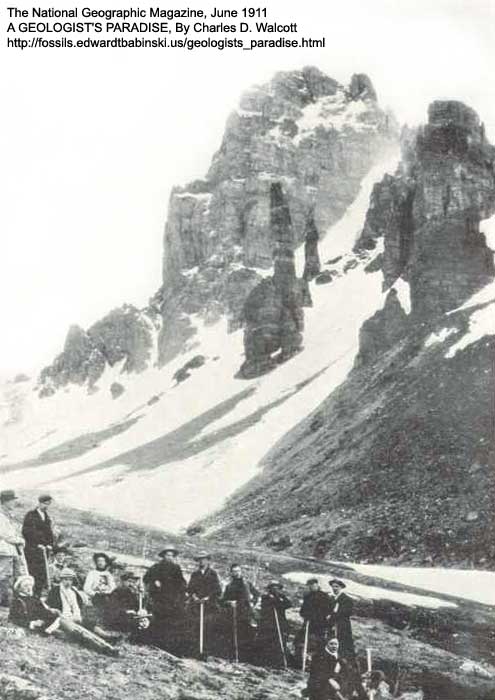
Mount Pinnacle
Mount Pinnacle and Sentinel Pass, Near Paradise Valley, British Columbia
This splendid peak, rising out of Paradise Valley like a jeweled needle tipped with pearl, stands side by side with Mount Temple, in the Canadian Rockies, and overlooks the celebrated "Valley of the Ten Peaks."
Photo by Rev. George Kinney
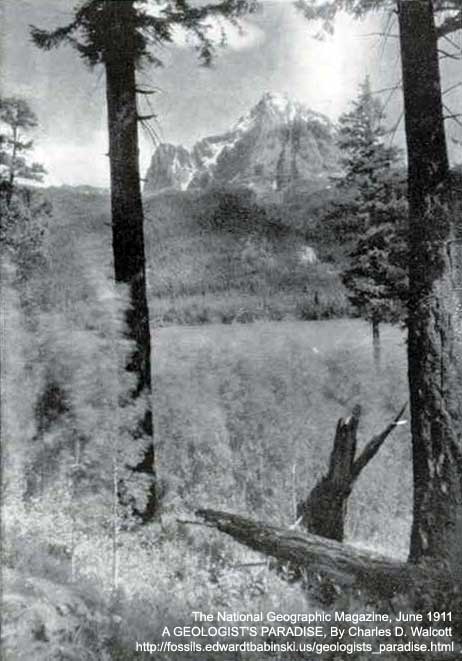
Canadian Rockies
Mount Peelee And The Yellowhead Lakes: Canadian Rockies
Yellowhead Pass, sentineled by Mount Peelee and the Yellowhead Mountains, offers for the transcontinental railroads the lowest and easiest gateway through the Canadian Rockies. Gigantic Douglas firs make picturesque the shores of the lakes in this region.
Photo by Rev. George Kinney

Mount Wapta
Mount Wapta, Near Field, British Columbia, And The First Camp Of The Alpine Club Of Canada
Photo by Rev. George Kinney


Two Rope Parties Of The Alpine Club Of Canada Crossing The Great Snow-Field On The Summit Of Mount Vice-President, Near Field, British Columbia, At Over 10,000 Feet Altitude
Photo by Rev. George Kinney
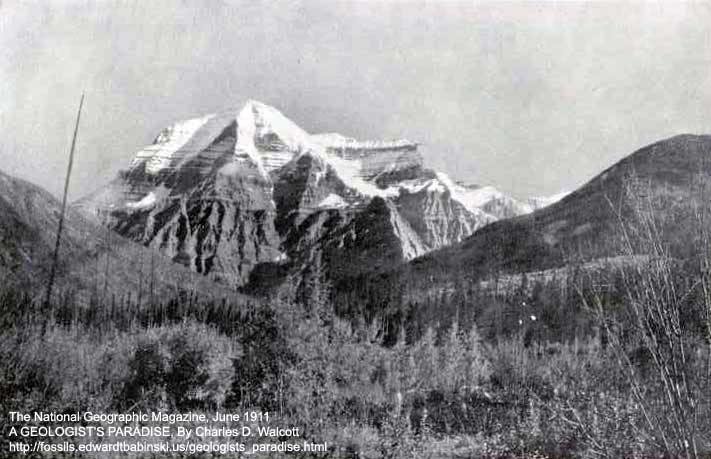
Mount Robson
Mount Robson (Nearly 14,000 Feet Altitude), King Of The Canadian Rockies
As the tourist on the Grand Trunk Pacific will see it, from the mouth of the Grand Forks, on the Fraser River. This monster peak, towering over 10,000 feet above Lake Kinney, in the valley below, at an average angle of over 60 degrees, was finally captured, in 1909, by two Canadians, Rev. George R.B. Kinney and his companion, Donald Phillips. It is the highest mountain yet discovered in the Canadian Rockies.
Photo by Rev. George Kinney
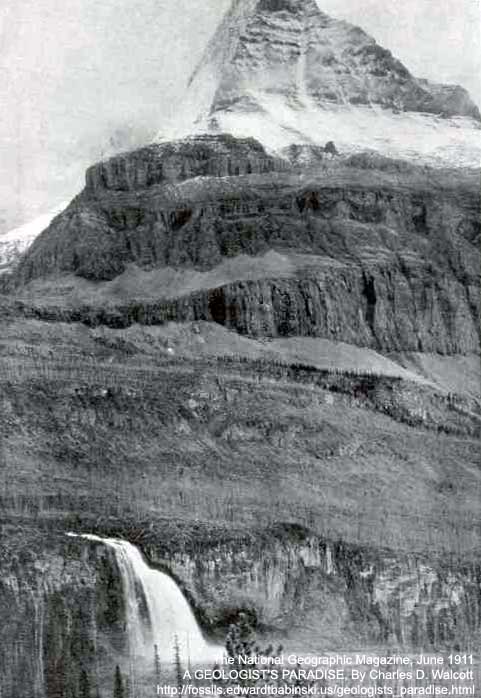
North face of Mount Robson
The north face of Mount Robson rises abruptly in a series of precipitous cliffs, rank on rank, to the very skies. At its base the Grand Forks River, swiftly flowing from Berg Lake, leaps a cliff as high as a Niagara and, plunging in a succession of superb falls through a gorge over 3,000 feet deep, sweeps through the "Valley of a Thousand Falls" on its way to the Fraser.
Photo by Rev. George Kinney
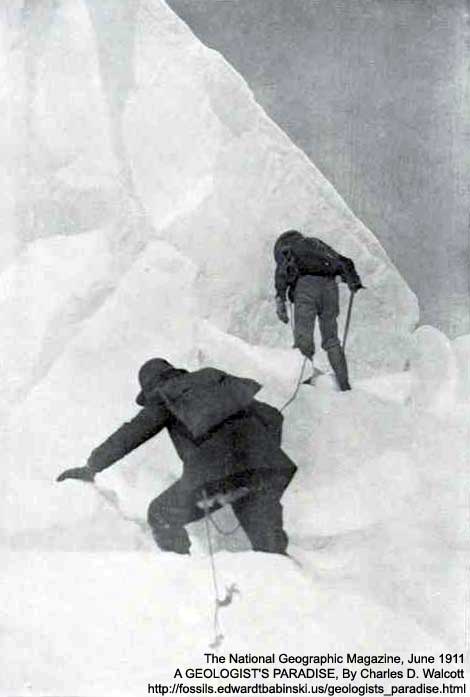
East of Mount Robson
Climbing The Ice-Cliffs Of The East Side Of Mount Robson; Canadian Rockies
Dr. A.P. Coleman, L.Q. Coleman and Rev. George R.B. Kinney working their way up the fearful ice-cliffs of the east side of Mount Robson in their unsuccessful attempt to climb the mountain in 1908. Leaving their camp at tree-line, for 14 hours they fought their way up those treacherous walls of ice amid constant dangers from hidden crevasses and roaring avalanches, but only attained an altitude of 11,700 feet.
Photo by Rev. George Kinney
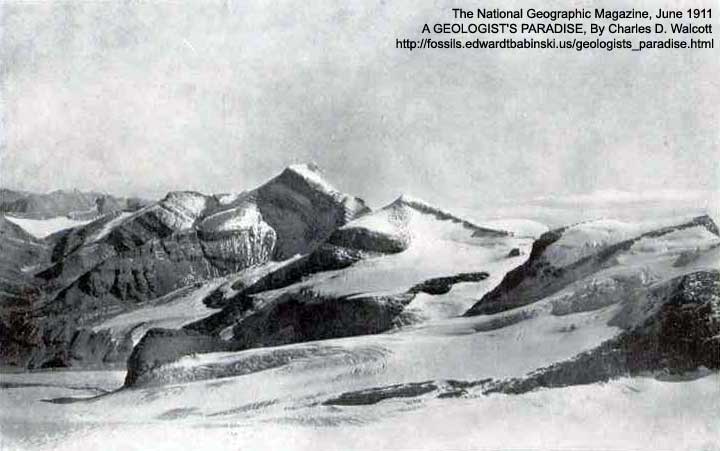
Canadian Rockies
Looking East And South From Mount Robson; Canadian Rockies
This view was taken from the east side of Mount Robson at an altitude of over 10,000 feet, high up on the crumbling cliffs from which the great East Glacier flows. From this altitude the snow-capped peaks to the south spread out like the surface of a rugged plain.
Photo by Rev. George Kinney
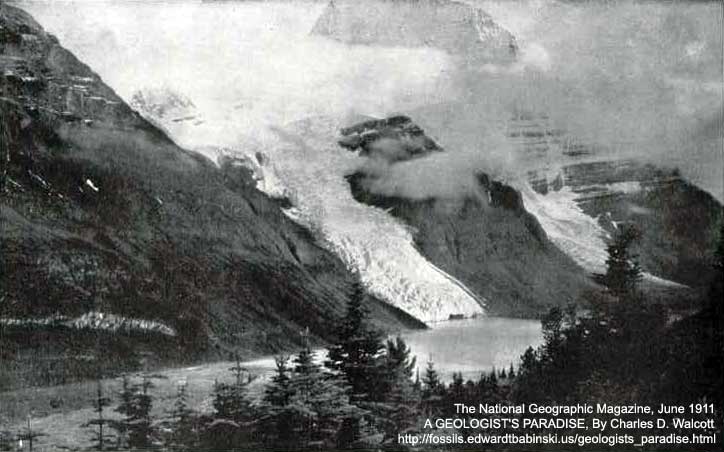
Canadian Rockies
East Side Of Mount Robson, Canadian Rockies, From Timber Lake
Looking from the east, Mount Robson, in the Canadian Rockies, rises out of one of the most beautiful valleys in all the world of alpine scenery. Six mighty glaciers, the least of which measures not less than a quarter of a mile wide, flowing from his rugged sides and those of the mountains opposite, pour their turbulent streams into the quiet waters of Berg Lake. This lake received its name because of its surface being constantly dotted with huge icebergs that plung into it from Tumbling Glacier midway its length.
Photo by Rev. George Kinney
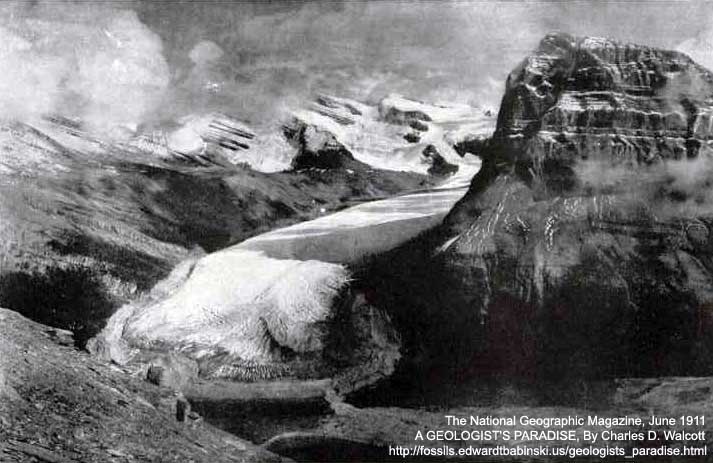
Glacier Mount Robson
The Big Glacier On The East Of Mount Robson
This mighty glacier, flowing from a huge snow-field on the east side of Mount Robson and curving in a wide crescent around the base of Mount Rearguard, is a mile wide and five miles long. The glacier forms a watershed, part of its waters flowing into the Pacific and part into the Arctic seas.
Photo by Rev. George Kinney
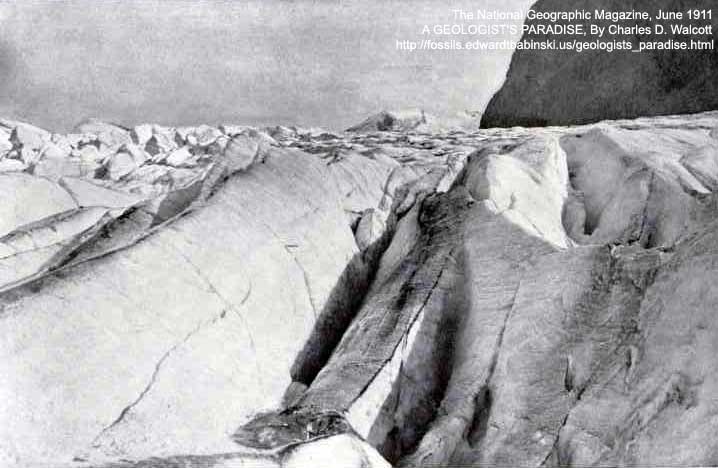
Glacier Mount Robson
Surface Of The Big East Glacier Of Mount Robson
The crevasses of this glacier are in some places several hundred feet deep, while its lateral and terminal moraines are thrown high on every side, and a splendid medial moraine marks its course.
Photo by Rev. George Kinney
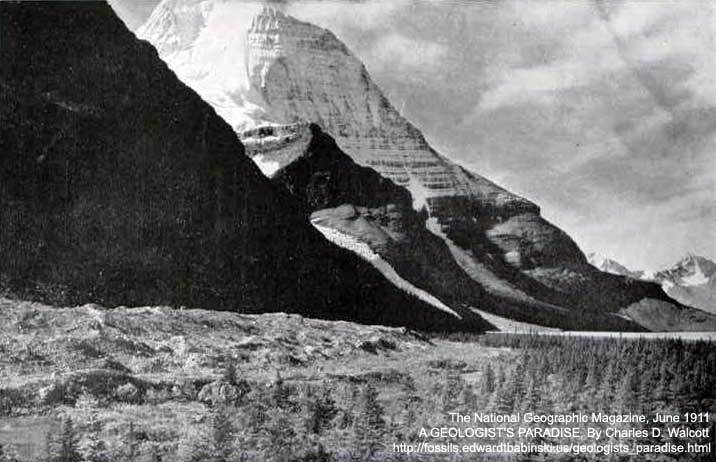
Mount Robson and Berg Lake
Mount Robson And Berg Lake From The Northeast: Canadian Rockies
So frightfully steep are its rugged sides, and so high does it rise out of its valleys (over 10,000 feet) and so frequent are the severe storms of the region that of all the expeditions that tried to capture Mount Robson, Mr. Kinney's, in 1909, was the only one that ever reached its summit. Even then he and his companions had to sleep several nights on its lofty snow-covered ledges and nearly perished.
Photo by Rev. George Kinney

REFERENCES

The Complete National Geographic, 111 Years; 1888-2000

RECOMMENDED READING

  • Creationist "Flood Geology" Versus Common Sense, -Or Reasons why "Flood Geology" was abandoned in the mid-1800s by Christian men of science

CHRISTIAN EVOLUTION RESOURCE LIST (UPDATED 10/9/2016)

  • PROMINENT CHRISTIAN EVOLUTIONISTS
  • CHRISTIAN WEBSITES THAT DEFEND EVOLUTION (aside from the massive new premier site, BIOLOGOS
  • E-MAILS FROM PROFESSORS WHO ARE CHRISTIAN EVOLUTIONISTS
  • HUMAN EVOLUTION (CREATIONISTS MAKE ADMISSIONS)

    1) PROMINENT CHRISTIAN EVOLUTIONISTS
    DR. RICHARD G. COLLING
    Dr. Colling is a fundamentalist Christian and chair of Biology at a fundamentalist Christian college, and also author of Random Designer: Created From Chaos To Connect With Creator. According to Dr. Colling, "It pains me to suggest that my religious brothers are telling falsehoods" when they say evolutionary theory is "in crisis" and claim that there is widespread skepticism about it among scientists. "Such statements are blatantly untrue," he argues. "Evolution has stood the test of time and considerable scrutiny... What the designer designed is the random-design process," or Darwinian evolution, Colling says. "God devised these natural laws, and uses evolution to accomplish his goals." ["Teaching Evolution at Christian College" by Sharon Begley, The Wall Street Journal (December 31, 2004)]


    DR. DENIS O. LAMOUREUX
    Dr. Lamoureux is a biologist/evolutionist and Evangelical Christian.
    He was involved in a written debate with Phillip E. Johnson, the lawyer and advocate of the "Intelligent Design hypothesis," which was published in book form as Darwinism Defeated? A debate between Phillip E. Johnson and Denis O. Lamoureux.


    DR. KEITH B. MILLER
    Dr. Miller is professor of geology at Kansas State Univ (not to be confused with Dr. Kenneth Miller, below) Dr. Keith Miller's website.
    He edited, Perspectives on an Evolving Creation, (William B. Eerdmans Publishing Company, 2003) that included essays by the following Christians:
    Terry Gray (Colorado State)
    James Hurd (Bethel College)
    Ted Davis (Messiah College)
    Robin Collins (Messiah College)
    David Wilcox (Eastern College)
    Mark Noll (Wheaton College)
    Jeff Greenberg (Wheaton College)
    Laurie Braaten (Judson College)
    John Munday, Jr. (Regent Univ.)
    Loren Haarsma (Calvin College)
    Howard Van Till (Calvin College)
    Deborah Haarsma (Calvin College)
    Warren Brown (Fuller Theological)
    David Campbell (University of Alabama)
    Jennifer Wiseman (Johns Hopkins Univ.)
    Conrad Hyers (Gustavus Adolphus College)
    George Murphy (Trinity Lutheran Seminary)
    Bob Russell (Center for Theology and Natural Sciences)


    DR. DAVID N. LIVINGSTONE
    Dr. Livingstone is the author of, Darwin's Forgotten Defenders: The Encounter between Evangelical Theology and Evolutionary Thought (Grand Rapids, MI: Eerdmans, 1987)


    DR. HOWARD J. VAN TILL
    Dr. Van Till is a Professor of Astronomy at Calvin College, and is the author of
    1) The Fourth Day: What the Bible and the Heavens Are Telling Us about the Creation (Grand Rapids, MI: Eerdmans, 1986)
    2) Science Held Hostage
    3) "The Creation: Intelligently Designed or Optimally Equipped?" Theology Today 55 (1998): 344-364


    DR. DAVID L. WILCOX
    Dr. Wilcox has a Ph.D. in Population Genetics, and is Professor of Biology at Eastern College, St. David's, PA. He is the author of God and Evolution (Nov. 2004)


    LARRY ARNHARDT
    Larry Arnhart is a Christian and also Professor of Political Science at Northern Illinois University. He is the author of Darwinian Natural Right: The Biological Ethics of Human Nature; and, Darwinian Conservatism (2005), whose blurb reads, "The Left has traditionally assumed that human nature is so malleable, so perfectible, that it can be shaped in almost any direction. Conservatives object, arguing that social order arises not from rational planning but from the spontaneous order of instincts and habits. Darwinian biology sustains conservative social thought by showing how the human capacity for spontaneous order arises from social instincts and a moral sense shaped by natural selection in human evolutionary history." Arnhardt has also debated I.D.ists at their conferences


    DR. KENNETH MILLER
    In a court case in Cob country, Georgia in which the school board lost their battle to insert "Evolution is only a theory" stickers inside a biology text, the "offending" book in question was written by a Christian, Dr. Kenneth Miller. How ironic. Besides having authored a widely used biology textbook, Miller is also the author of Finding Darwin's God: A Scientist's Search for Common Ground Between God and Evolution.

    More on Dr. Miller at Christianity Today's website:

    "A Somewhat Higher Opinion of God": A conversation with biologist Ken Miller. Interview by Karl W. Giberson

    "Finding Darwin's God: A conversation with biologist Ken Miller."
    Interview by Karl W. Giberson


    DR. FRANCIS COLLINS
    Dr. Francis Collins is Director of the Human Genome Project. Collins has stated: "I am unaware of any irreconcilable conflict between scientific knowledge about evolution and the idea of a creator God; why couldn't God have used the mechanism of evolution to create?...In my field, biology, because of the creationists the standard assumption is that anyone who has faith has gone soft in the head. When scientists like me admit they are believers, the reaction from colleagues is 'How did this guy get tenure?'" (Gregg Easterbrook, "Science and God: A Warming Trend?" Science, Vol. 277, No. 5328, Aug. 15 1997, p. 890-893)

    More on Dr. Collins at Christianity Today's website:

    "The Genome Doctor: The director of the National Human Genome Research Institute answers questions about the morality of his work" by Francis Collins


    DR. JOHN POLKINGHORNE
    Dr. Polkinghorne is an ordained Anglican priest, former Cambridge professor of theoretical physics.
    He is also the author of
    1) Quarks, Chaos, and Christianity: Questions to Science and Christianity (New York: Crossroad, 1994)
    2) Science and Theology: An Introduction (London: SPCK, 1998)
    3) The Work of Love: Creation as Kenosis (Grand Rapids, MI: Eerdmans, 2001) A book of essays by assorted theistic evolutionists that explores the Biblical concept of kenosis (self-emptying) and the doctrine of creation in light of evolutionary thought.


    DR. DONALD NIELD
    Dr. Nield is Professor of Engineering Science at Auckland University, and author of God Created the Heavens and The Earth.


    DR. GRAEME FINLAY
    DR. Finlay is a Cell Biologist who lectures in General Pathology in the Department of Molecular Medicine and Pathology at Auckland University, and is the author of
    1) A Seamless Web: Science and Faith; Evolving Creation
    2) God's Books: Genetics and Genesis.


    DR. DENIS EDWARDS
    Dr. Edwards is the author of
    1) The God of Evolution: A Trinitarian Theology (New York: Paulist, 1999)
    2) Jesus and the Cosmos (New York: Paulist, 1991)


    DR. JOHN F. HAUGHT
    Dr. Haught is the author of
    1) Deeper Than Darwin: The Prospect for Religion in the Age of Evolution (Boulder, CO: Westview, 2003)
    2) God After Darwin: A Theology of Evolution (Boulder, CO: Westview, 2000).


    DR. STANLEY L. JAKI
    Dr. Jaki is a Benedictine priest with doctorates in both theology and physics, and the author of
    1) Cosmos and Creator (Scottish Academic Press, l979; Regnery Gateway, 1980), An analysis of the bearing of modern cosmological theories on the Christian dogma of the creation of the universe, followed by the history of that dogma, its philosophical presuppositions, and its relation to evolutionary theories of man
    2) Genesis 1 Through the Ages (London: Thomas More Press, 1992) with illustrations. A history of the interpretations of Genesis 1 from biblical times to the present day, with an emphasis on the ever-present lures of concordism. Eight lectures delivered April 25- May 9, 1992, in New York on behalf of Wethersfield Institute
    3) Bible and Science (Front Royal, VA: Christendom Press, 1996) An analysis of the biblical world view and basic Biblical propositions
    insofar as they relate to science and to its history.

    2) CHRISTIAN WEBSITES THAT DEFEND EVOLUTION

    John Polkinghorne's web site with helpful links.

    Darwin's Forgotten Christian Defenders

    Three Cheers For Christian Evolutionists

    From Abandoning Geocentrism To Accepting Evolution: A "Liberal Trend" Among Evangelical Christians?

    Evolving Interpretations of the Bible's "Cosmological Teachings"--Or--Does the Bible "Teach Science?"

    DWISE1'S Creation/Evolution Page
    (On the Danger of Losing One's Faith Due to Fallacious Creationist Arguments, and why Christians must remain open to theistic evolution)

    Christian Evolutionists (and lots of old-earth arguments, including testimonies of former Young-Earthers)

    Dr. Robert J. Schneider's Science and Faith essays

    Dr. Allan H. Harvey's essays

    Dr. Anthony Garrett (former atheist and member of Australia's skeptic society who became a Christian evolutionist)

    John D. Callahan (aithor of Science and Christianity, and his debate with YEC Kent Hovind is on the web)

    ChristiansForEvolution newsgroup

    The Pope's Message On Evolution

    Fine-Tuners Who Reject I.D. Arguments

    Howard J. Van Till (Professor Emeritus of Physics and Astronomy at Calvin College)

    Carl Drews

    Christian Evolutionism at the ASA website (American Scientific Association, an organization of Evangelical Christians who are scientists,includes both old-earth creationists and theistic evolutionists)

    Glenn Morton

    or see Glenn's pieces here


    Stephen Meyers
    's website

    Webpage that features the article, "I.D. For I.Dummies"

    Zygon (journal)

    Voices For Evolution: Statements From Religious Organizations


    3) E-MAILS FROM PROFESSORS WHO ARE CHRISTIAN EVOLUTIONISTS

    Ed,

    You might add to your List of Prominent Christian Evolutionists the following names: Peter Dodson (dinosaurs) and Simon Conway Morris (Cambrian). Apparently Sean Carroll, the 'evo-devo' guru is a Catholic who thinks God is real - thus, I presumes fits the bill. My guess is we have about 5000+ "theistic evolutionists" of various stripes teaching science at the 100-odd schools of the "Council on Christian Colleges and Universities"--but most of us keep our heads down--hoping to 'pass' as "real" Christians (in lieu of our fellow brethrens' suspicions to the contrary).


    David L Wilcox


    Ed -

    Thanks for the list. I am honored and pleased to be included on your list among such august company as Dr. Kenneth Miller, Rev. Dr. John Polkinghorne, Glenn Morton, and Dr. Francis Collins! You have the majority of my favorites already listed. I have a section on "Theistic Evolution" on my References page that has a few of yours.

    Go there and search for "Theistic Evolution" and you'll find my shorter list.

    Consider adding Michael Dowd and his Great Story.

    Dowd comes across as kind of "New Age"-y, but in his presentation I could not find anything that contradicts the Bible. There is also the Nebraska Religious Coalition for Science Education.

    One promiment name I did not find on your list is that of Rev. Dr. Francisco Ayala, an ordained priest and scientist.

    You might contact him to verify that it's the right guy, and that he is an ordained priest.

    When I started my web site in 2000 there were very few sites on the Internet that had anything positive to say about theistic evolution. Now there are plenty that advocate the view that God can (and did) create through the process of evolution. Francis Collins in particular can be paraphrased as saying, "What's the problem?"

    I think Chistians like me have woken up to the fact that young-earth creationism won't go away just by ignoring it. We have also realized that the bogus claims of creationism have turned many people away from accepting Jesus Christ as their Lord and Savior! Arguing about scientific theories is one thing, but distorting the Gospel (or adding to it) is quite another thing entirely! See Galatians 1:8-9 for details.

    Lest anyone write off us TE people as a bunch of liberal compromisers, I am a member of the Anglican Mission in America. Although I dislike political labels, the AMiA is generally considered to be a conservative offshoot of the Episcopal Church. So although there may be a correlation, it's not true that only liberal Christians accept evolution.

    If you're interested in my credentials, I'm currently sweating through the second semester of Atmospheric Dynamics on my way to earning a Master's Degree in Atmospheric Science. Theistic meteorology can be a useful analogy! When I graduate I'll feel free to call myself a scientist, but for now I'm a software engineer working with meteorological data. And trying to clear the path to Jesus, despite the obstacles that others would put in the way.

    In Christ's service,
    Carl Drews


    Ed

    You might want to say John Polkinghorne is "author of many books including:" and add that he is a winner of the Templeton Prize and the founding President of ISSAT

    You could also add Arthur Peacocke, Prof Simon Conway Morris FRS and Dennis Alexander (author of Rebuilding the Matrix)

    YIC
    Nicholas


    I recommend the following:

    All the works of Pierre Teilhard de Chardin.
    All the works of Karl Schmitz-Moormann, Especially his Theology of Creation in an Evolutionary World.

    Good luck,
    Philip Hefner


    Please feel free to add me to the list of Christian evolutionists.
    I direct the course on the "Epic of Creation" at the Zygon Center for Religion and Science at the Lutheran School of Theology at Chicago. I am an Orthodox Christian, and I wrote the book "Beauty and Unity in Creation: The Evolution of Life", Light and Life Publishers, 1996. I have also attached my CV which lists my scientific accomplishments.

    Nevertheless, if this does not fit with the format of information you are posting, please feel free to disregard this email. Zygon thought I should supply you with the needed information.

    Best wishes in your endeavors,
    Gayle

    Gayle E. Woloschak, Ph. D.
    Professor, Department of Radiology
    Department of Cell and Molecular Biology
    Feinberg School of Medicine
    Chicago, IL


    Dear Ed

    Thank you for your very informative email listing many Christians who are committed to the God who is sovereign over natural process. And I wish you well in your efforts against the spread of 'Creationism'.

    In New Zealand, where I live, American 'Creationism' has got an almost total hold on the evangelical public. However, here and in Australia too, evangelical theologians and Christians who are scientists (in universities and government research institutes) are solidly behind mainstream science.

    Very useful contacts in the UK would be geneticists Dr Caroline Berry and her husband Prof. Sam Berry. They represent Christians in Science, the UK-based organisation of evangelicals with an interest in science.

    In New Zealand, one notable contact would be Prof Gareth Jones, who is a structural biologist who has written extensively on Christianity and science themes.

    The evangelical organisation in Australia which has sought to withstand the 'Creationist' onslaught is ISCAST, for whom a contact man is their Administrator Mr Richard Gijsbers. He could put you in touch with many highly ranked scientists who are Christians.

    I submit some websites (listed in my booklets which you have presented in your email) which should give useful contacts in various countries. Christians in Science (CiS).

    The Victoria Institute

    The above two organizations publish the journal Science and Christian Belief. Scibel

    Institute for the Study of Christianity in an Age of Science and Technology (ISCAST)

    American Scientific Affiliation (ASA)

    The ASA publishes the journal Perspectives on Science and Christian Faith.

    Canadian Scientific and Christian Affiliation (CSCA)

    Affiliation of Christian Geologists (ACG)

    I can provide you with other contacts if you would like them! I attached an article that I and some fellow Christians published last year. You may find it interesting.

    If you can suggest how my booklets can be distributed in the USA, I would be very glad to hear any suggestions. Keep up your good work.

    Yours sincerely in Christ
    Graeme Finlay
    PhD

    P.S., Humans and chimps share an extensive collection of particular genetic markers. [For example, our DNA shares with that of other primates a vast catalogue of genetic parasites--several million in number, comprising 50% of the human genome--that provide a consistent outline of primate evolutionary relationships. Remarkable studies using the 'Alu' genetic parasite as an evolutionary marker have been done by Salem A-H, Ray DA, Xing J et al (2003). Alu elements and hominid phylogenetics. Proc Natl Acad Sci USA 100, 12787; Xing JC, Salem AH, Hedges DJ et al (2003). Comprehensive analysis of two Alu Yd subfamilies. J Mol Evol 57 Suppl 1, S76.] The shared history to which such common markers testify establishes conclusively that human and chimp genomes have been copied from the same line of ancestors. It is a conclusion that we must live with. And when the details of the chimp genome are published with great fanfare in the scientific literature and the popular media, it is a conclusion for which we must give a Christian interpretation.

    For a discussion of evolutionary genetics from a Christian perspective see Rolston H (1999). Genes, Genesis and God. (Cambridge: CUP).

    For a discussion of the compatibility between evolutionary and religious perspectives, see and Conway Morris S (2003). Life's Solution: Inevitable Humans in a Lonely Universe (Cambridge: CUP).

    The dangers inherent in Christians making the wrong choices are well expressed by the evangelical historian Noll MA (1994). The Scandal of the Evangelical Mind. (Grand Rapids: Eerdmans, and Leicester: IVP).

    Graeme Finlay PhD is a cell biologist who lectures in scientific pathology at the University of Auckland, and should be addressed in any correspondence.
    Warren Judd PhD lectured in molecular biology for several years in the University of Auckland, and is currently editor of the NZ Geographic Graham O'Brien PhD is a molecular geneticist who is training for the ministry. He is a member of the Inter-Cchurch Bioethics Council Ross Prestidge PhD, a biochemist, is a Senior Staff Scientist at the Genesis Research and Development Corporation Ltd., Auckland. Andrew Shelling PhD a molecular biologist, lectures in Reproductive Science at the University of Auckland, and is currently President of the Human Genetics Society of Australasia (NZ Branch).

    4) HUMAN EVOLUTION (CREATIONISTS MAKE ADMISSIONS)
    Two quotations from creationists:

    `I was surprised to find that instead of enough fossils barely to fit into a coffin, as one evolutionist once stated [in 1982], there were over 4,000 hominid fossils as of 1976. Over 200 specimens have been classified as Neandertal and about one hundred as Homo erectus. More of these fossils have been found since 1976.
    --Michael J. Oard [creationist], in his review of the book, Bones of Contention -- A Creationist Assessment of Human Fossils, in the Creation Research Society Quarterly, Vol. 30, March 1994, p. 222

    `The current figures [circa 1994] are even more impressive: over 220 Homo erectus fossil individuals discovered to date, possibly as many as 80 archaic Homo sapiens fossil individuals discovered to date, and well over 300 Neandertal fossil individuals discovered to date.
    Marvin L. Lubenow [creationist], author of Bones of Contention -- A Creationist Assessment of Human Fossils, in a letter to the editor of the Creation Research Society Quarterly, Vol. 31, Sept. 1994, p. 70

    "Transitional Fossils of Hominid Skulls" by Carl Drews, a Christian evolutionist, "By 2000 enough pre-human fossils had been recently discovered to form a clearer picture of human ancestry, something that was difficult 20 years earlier. This web page contains an illustration of those skulls, displayed in a lineup so that you can compare them and see if they look like transitional fossils or not. I have provided my own commentary, but feel free to analyze them yourself and draw your own conclusions."

    Arguments We Think Creationists Should Not Use (A must read article at the Young-Earth Creationist site, Answers in Genesis)

    "Creationists Admit Difficulties With Their Hypothesis"

Darwin's Forgotten Christian Defenders

By the very early 1900s, even conservative theologians at Princeton Theological Seminary acknowledged to varying degrees:

a) the lengthy history of the earth,
b) the transmutation of species by evolution, and even,
c) an evolutionary past for the human physical form.

Such theologians included B.B. Warfield, the famous Presbyterian inerrantist, whose famed defense of Scriptural inerrancy and plenary verbal inspiration was published in the Princeton Review (1881), and republished since then (B.B. Warfield and Hodge, A.A., Inspiration. Grand Rapids: Baker, 1979), and who continues to be highly regarded among conservative Protestants.

Even when the twelve-volume series, The Fundamentals (an interdenominational work that spearheaded this century's "fundamentalist" movement), was published between 1910 and 1915, it contained the cautiously pro-evolution stances of conservative Christian theologians like George Frederick Wright, R.A. Torrey, and James Orr. (It was only in the eighth collection of The Fundamentals that the previous cautious advocacy of evolution was matched by two decisively and aggressively anti-Darwin statements, one by someone who remained anonymous and another by the relatively unknown Henry Beach, both of whom lacked the theological and scientific standing of the senior evangelicals already mentioned.)

Reverend Orr, one of the more renowned contributors to The Fundamentals, was a theologian of the United Free Church College in Glasgow and widely respected as an apologist for Evangelicalism, but expressed doubts as to how literal, Genesis, chapter 3, ought to be taken: "I do not enter into the question of how we are to interpret the third chapter of Genesis -- whether as history or allegory or myth, or most probably of all, as old tradition clothed in oriental allegorical dress..." [James Orr, The Christian View of God and the World (1897), p. 185, see also p. 447

Evangelical Christian apologist, C. S. Lewis, admitted he was not disturbed by the thought of Genesis being "...derived from earlier Semitic stories which were Pagan and mythical" [C. S. Lewis, Reflections on the Psalms (London: Collins, Fontana Books, 1958), p. 93]. "We read in Genesis (2:7) that God formed man of the dust and breathed life into him. For all the first writer knew of it, this passage might merely illustrate the survival, even in a truly creational story, of the Pagan inability to conceive true Creation, the savage, pictorial tendency to imagine God making things 'out of' something as the potter or the carpenter does." [Lewis' essay, "Scripture," in Reflections on the Psalms] Lewis found more truth in the story of the "Garden of Eden" when he regard it as a myth than as history. [See, Michael J. Christensen, C. S. Lewis on Scripture: His Thoughts on the Nature of Biblical Inspiration, The Role of Revelation and the Question of Inerrancy (Waco, Texas: Word Books, 1979), pp. 34-35)]

Evangelical Christian theologian, Henri Blocher, wrote: "The style [of Genesis chapter 3] is lively and picturesque; the pictures take shape spontaneously in the reader's mind. The Lord God takes on a human form: we see him mold clay, breathe into man's nostrils, walk in the garden when the breeze gets up and make for the guilty couple better clothes than their improvised cloths. There is a dream-like garden with strange trees and a cunning animal who opens a conversation; you could believe you were in one of those artless legends, one of those timeless stories which are the fascination of fokelore..." [Henri Blocher, In the Beginning: The Opening Chapters of Genesis (InterVarsity Press, 1984)]

Other Evangelical Christian theologians and commentators on Genesis who take the ancient Near Eastern background of Genesis seriously, including related myths, folklore, and pre-scientific cosmologies of the ancients, include:

John H. Walton, past professor Old Testament at Moody Bible Institute, and professor at Wheaton Theological Seminary, author of Genesis: The NIV Application Commentary (Zondervan, 2001) Take a peek at it next time you're in Zondervan's Bookstore, or some other major Evangelical Christian bookstore, and note especially what he has to say about "the firmament," the use of "satan" in the old testament, and whether the serpent was originally understood as just being a "serpent," or not. Dr. Walton's keynote address at Wheaton's Cosmology Conference in 2003 (where he presented his view of Genesis 1 to the conference attendees).

Conrad Hyers, former Bob Jones University student and former Chair of Religion at Gustavus Adolphus College (retired), author of The Meaning of Creation: Genesis and Modern Science (Word, 1984) Also author of the online article: "Genesis Knows Nothing of Scientific Creationism:
Interpreting and Misinterpreting the Biblical Texts" NCSE Issue 12 Volume 4
Frederick E. Greenspahn, Jewish scholar, aurhot of "Biblical Views of Creation" NCSE Issue 13 Volume 4

Dr. Stephen Meyers (Th.M., Old Testament Studies from Westminster Theological Seminary in 1989. Thesis entitled, "A Biblical Cosmogony." Dr. Meyers' exegesis of Genesis appears at his site.

It is agreed upon by all historians that at least some early fathers of the Christian church did believe in a flat earth. And those fathers who believed in a spherical earth still believed that the spherical earth did not move and that the "firmament" was solid. Holy Scripture continued to be cited in support of those latter two assertions for centuries. Origen called the firmament "without doubt firm and solid" (First Homily on Genesis, FC 71). Ambrose, commenting on Genesis 1:6, said, "the specific solidity of this exterior firmament is meant" (Hexameron, FC 42.60). And Saint Augustine said the word firmament was used "to indicate not that it is motionless but that it is solid and that it constitutes an impassable boundary between the waters above and the waters below" (The Literal Meaning of Genesis, ACW 41.1.61).
More importantly, for millennia before the early church, ancient Near Eastern civilizations had agreed the earth was flat, you can see it in their writings and pictures of the cosmos. The flat earth view was undeniably prominent in Babylon, Egypt, and Greece during the time when the Old Testament was written. Even during the intertestamental period (after the Old but before the New) Jewish literature like the Book of Enoch spoke unmistakably of the shape of the earth as flat. The New Testament writers from the Gospels to Rev. also seem to take for granted the flatness of the earth. So whatever the "early church fathers" believed, such a question is not of major importance since they lived after the Old Testament, the Intertestamental period, and the New Testament, which were all "flat-earth" thinking periods of Biblical composition.

Newton and Darwin and Wallace and "false analogies"

I do claim that Darwin's lies and dishonest in order to get his theory accepted, is part of the "evidence against`the theory of evolution'".

ED: It would be more to the point to discuss a wide variety of lines of evidence concerning Natural Selection, both pro and con (from Darwin's day to our own). But if you really think you can bring down "Darwinism" simply by citing old "cases in which _Darwin_ was dishonest," go right ahead. (Of course why focus on Darwin alone when "natural selection" had two authors, not just one. There was Wallace too. And by the way, Darwin was not an atheist but an agnostic, and Wallace was a theist. If I recall correctly, Wallace believed that the evolution of man's mind involved a designing influence rather than a purely naturally selective one. But for most evolutionary processes in nature, Wallace remained pro-natural selection.)

And if you want to discuss cases in which Darwin was dishonest, why not also discuss the cases in which Darwin was honest? One thing's for sure, Darwin held his temper to a relatively greater extent than many who slandered him in the press of his day.

Besides, if you want to debate a hypothesis on the basis of the "honesty or dishonesty" of its leaders then let's discuss two thousand years of Christian history with its slanderings of Christian against Christian, and of dishonest tactics like burning opponents books and even burning opponents -- including fellow Christians. You can even compare young-earth "Flood geology" Christians and their "honesty" and "honest" portrayals of old-earth and theistic evolutionary arguments, and vice versa. Or better yet, study the way that the Gospel of Matthew cites verses from the Old Testament and applies them to Jesus, to see how "honestly" the original contexts of each of those verses is represented. [A good place to begin such a study is with a book titled, THE JEW AND THE CHRISTIAN MISSIONARY.]


Apart from the word "science" there is no meaningful comparison between "Darwin's ... theory of evolution" and "Newton's ... theory of gravity". Newton had to invent a whole new branch of mathematics, calculus, in order to develop his "theory of gravity", which is expressed with mathematical objectivity and precision.

ED: Gravity is indeed mathematically precise. Though I have read that even today the calculation of how THREE objects in three-dimensional space interact gravitationally on one another remains an extraordinarily difficult problem. And there are plenty of advanced physics problems and astronomical questions today for which science has no definitve answers, but some of which are being fleshed out in hypotheses and semi-verified theories. Though as of yet, I haven't seen any physicists resorting to simply invoking "I.D." as an "answer." No, I'm afraid they are going to continue to seek mathematical ways to model the regularities of nature, including the evolution of galaxies, stars, planets, and the development of all the other elements from simple hydrogen atoms.

Speaking of Darwinism, there is observation and mathematics involved in determining mutation ratios, and genetics is opening further observational doors to inner genetic changes, and making it possible to read the differences between genomes like geologists read the fossil evidence in the stratigraphic record. And biological science like physical science, will probably continue to seek mathematical ways to model changes in natures, and will continue to do so, rather than resort to the explanation that "God did it that way." By the way, even some young-earth creationists agree that "micro-evolutionary" changes occur, which I suppose means that they also agree that mutations and natural selection also may play a part, at least in cases of "microevolution."

So if you want to discuss Natural Selection, then just continue to read about experiments related to it, and continue to discuss it. And visit the website, "Was Darwin Wrong?" that contains some in-depth reviews of anti-Darwinian books by a university biologist.


Darwin himself admitted in his Origin of Species, that his "theory of evolution", was not a "fair" and "balanced" presentation of the "facts and arguments": "For I am well aware that scarcely a single point is discussed in this volume on which facts cannot be adduced, often apparently leading to conclusions directly opposite to those at which I have arrived. A fair result can be obtained only by fully stating and balancing the facts and arguments on both sides of each question; and this is here impossible." (Darwin C.R., "The Origin of Species by Means of Natural Selection," [1872], Everyman's Library, J.M. Dent & Sons: London, 6th Edition, 1928, reprint, p.18)

ED: I sent an email to the group regarding a few quotations from Darwin including the one you have cited above. That email contains my reaction to your citation above. (But please continue reading my further replies below.)


So your argument is an example of "the fallacy of false analogy": "THE FALLACY OF FALSE ANALOGY. Few techniques of reasoning are so potentially useful-or so potentially dangerous-as analogy. When we reason by analogy we attempt to advance our position by likening an obscure or difficult set of facts to one that is already known and understood and to which it bears a significant resemblance. The fallacy of false analogy arises when the comparison is an erroneous one that distorts the facts in the case being argued. Drawing attention to likenesses can be extremely useful so long as the two things being compared resemble each other in important respects and differ only in trifling ways. If, on the contrary, they are alike in unimportant ways and different in important ways, then there is no valid analogy between them and a fallacy of false analogy results. Merely to seize upon some slight similarity as a basis for concluding that what is true of one is also true of the other will usually lead one astray. ... To expose a false analogy-or an imperfect analogy, as it is sometimes called-it is necessary to establish that the two things being compared resemble each other in insignificant ways, while they differ in significant ways." (Engel S.M., "With Good Reason: An Introduction to Informal Fallacies," St. Martin's Press: New York NY, Fourth Edition, 1990, Pp.150-151)

ED: Before you _quid pro quo_ me, please read what I wrote above in response to your attempts to defend your own fallacious argument, viz., citing Darwin's "dishonesty" as being equal in all ways to "evidence against the theory of evolution."


"According to anthropologist Loren Eiseley, Darwin appropriated the work of Edward Blyth, a little-known British zoologist who wrote on natural selection and evolution in two papers published in 1835 and 1837. Eiseley points to similarities in phrasing, the use of rare words, and the choice of examples. While Darwin in his opus quotes Blyth on a few points, notes Eiseley, he does not cite the papers that deal directly with natural selection, even though it is clear he read them. The thesis has been disputed by paleontologist Stephen J. Gould."

ED: I'm familiar with that. But even if Gould's dispute of it is incorrect, and Darwin did employ words and ideas and examples from Blyth, plagiarism is hardly reason to doubt anyone's hypothesis, only the name of its originator. So if we called it "Blythinism" instead of "Darwinism" would that suit you?

(This also reminds me of how both the Hebrew account of creation and the Flood story do not list any of the original sources which inspired them or from which they were plagiarized to various degrees. The proverbs of Solomon have even turned up in ancient Near Eastern literature that pre-dates the days of Solomon. Many ancient Near Eastern sayings had earlier origins in various collections of wise sayings amongst the Egyptians and Babylonians. Solomon, or later editors of Solomon's wise sayings, probably had a lot to choose from, again, without listing the proper references as to each saying's prior origin.)


But Eiseley is not the only critic of Darwin's acknowledgment practices. He was accused by a contemporary, the acerbic man of letters Samuel Butler, of passing over in silence those who had developed similar ideas. Indeed, when Darwin's On the Origin of Species first appeared in 1859, he made little mention of predecessors. Later, in an 1861 `historical sketch' added to the third edition of the Origin, he delineated some of the previous work, but still gave few details. Under continued attack, he added to the historical sketch in three subsequent editions. It was still not enough to satisfy all his critics. In 1879, Butler published a book entitled Evolution Old and New in which he accused Darwin of slighting the evolutionary speculations of Buffon, Lamarck, and Darwin's own grandfather Erasmus." (Broad, William J. & Wade, Nicholas [science writers, The New York Times], "Betrayers of the Truth: Fraud and Deceit in the Halls of Science," Simon and Schuster: New York NY, 1982, pp.30-31). [...]

ED: Today we have historians of evolution that have helped fill in the gap, i.e., and who have written far more than mere "historical sketches" as to the many influences that engaged Darwin's mind prior to writing "The Origin of Species." Probably more influences than Darwin himself can recall.


As can be seen, this is actually one of my Darwin's dishonesty items, and was in fact one of the quotes that got me started on this Darwin's dishonesty issue.

ED: It would be more to the point to discuss a wide variety of lines of evidence concerning Natural Selection, both pro and con (from Darwin's day to our own). But if you really think you can bring down "Darwinism" simply by citing old "cases in which _Darwin_ was dishonest," go right ahead.